






In the workplace, the "90-90-90" sitting rule is an office guideline for addressing the adverse effects of prolonged sitting. But in the medical world, it’s a biological requirement.
Pediatricians and occupational therapists teach the 90-90-90 Rule to parents before a child even learns to walk. Why? Because an infant requires this specific alignment—ankles, knees, and hips at 90 degrees—to breathe deeply and swallow food safely without choking.
90-90-90 Rule, the foundational posture for human survival and growth.
Before writing this article, the author (me) tried to sit and tuck the feet under the chair. After 20 minutes, I felt a pulling sensation in the muscles on both sides of my buttocks, followed by a dull ache in my legs.
When people sit in a way that deviates from the 90-90-90 Rule, the muscles can no longer rely on the skeleton to support them. The lower back, neck, and hip flexors must "fire" constantly to keep the body from collapsing. This micro-tension is why they feel physically exhausted at 5:00 PM, even if they’ve "done nothing" but sit all day. It is known as Static Load.
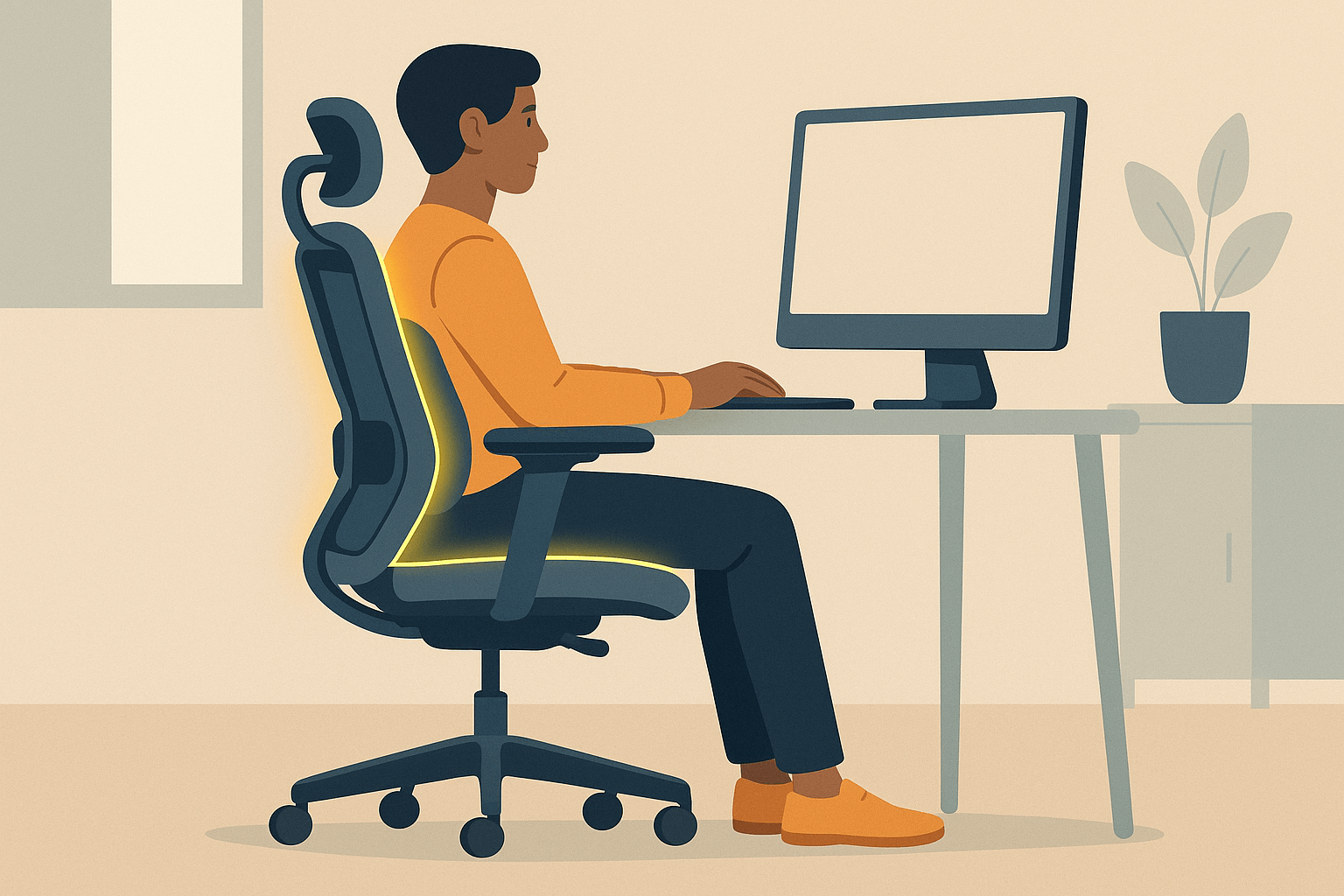
Right 90-90-90 Rule in the office: Ankles are at a 90° angle to the ground. Knees should form a 90° angle with the seat cushion and be spaced 2-3 inches apart. Torso forms a 90° angle with the thigh.
Besides the 90-90-90 Rule, read our article “5 Warning Signs Your Workstation is Damaging Your Health” to understand more details to improve your work life.

"90-Degree Audit" Summary for Ergonomics
| Joint | Healthy Angle | Red Flag |
| Hips | 90° (Torso to Thigh) | Sliding forward (Slouching) |
| Knees | 90° (Thigh to Shin) | Tucking feet back or crossing legs |
| Ankles | 90° (Shin to Foot) | Heels lifted or feet dangling |
| Elbows | 90° (Arm to Desk) | Reaching forward or elbows flared out |
To the untrained eye, the 90-90-90 Rule appears rigid and uncomfortable. To an ergonomist, it is the optimal offloading strategy. They aim to make your skeleton carry your weight rather than your muscles.
In the ergonomic field, elbows are the "Secret" 4th 90, which is the best for preventing "Mouse Shoulder" and Carpal Tunnel. Elbows form a 90° angle with the desk, meaning the forearms are parallel to the desk.
How to check? If you feel tingling in your pinky or burning in your wrist in long-term work, it means you have the wrong posture.
Science Behind 90-90-90-90 Rule
If you ask the average person why they should sit upright, they’ll likely say "to save my back." Not only that, the science behind the 90-90-90 Rule is a biological optimization strategy. In the field of developmental therapy, there is a concept called "Stability = Ability."
1. Stability = Ability: The Neurological Performance Hack
When you achieve 90-90-90, your "base of support" is maximized. Your nervous system receives a signal that you are safe and stable. You’ll find that your ability to concentrate on complex tasks—like coding, writing, or analyzing data—increases simply because your brain isn’t busy trying to keep your body in its chair.
2. The Respiratory & Digestive "Open Highway."
When your hips are at 90 degrees, and your spine is neutral, your ribcage remains "open." At this time, you ensure maximum oxygen saturation in your blood—the literal fuel for your brain. And the stomach and intestines will avoid physically squeezing to prevent acid reflux.
3. Nerve Tension vs. Nerve Glide
Maintaining 90-degree angles keeps your nerves in a "neutral glide" position. This prevents the micro-friction that leads to Carpal Tunnel Syndrome and that nagging "burning" sensation between your shoulder blades.
4. Preventing "Ischemic Pressure."
By keeping your knees at 90 degrees and your feet flat, you distribute your body weight evenly across the seat pan and the floor. This keeps your "circulatory highway" open, ensuring that nutrients reach your muscles and waste products (like lactic acid) are carried away.
So we said in terms of ergonomics that the 90-90-90 Rule isn't about "looking straight." It’s about removing the biological friction that slows down your body and mind.
“Dynamic” 90-90-90
The biggest criticism of the 90-90-90 rule is that it feels “robotic.” No human being can stay perfectly still at right angles for eight hours straight. In fact, staying in any static position—even a “perfect” one—eventually leads to muscle fatigue.
The secret to modern ergonomics isn’t Static Perfection; it’s Dynamic Support.
Movement within the “Golden Ratio.”
True ergonomic health happens when your chair maintains your 90-degree foundation even as you shift, lean, or reach for a coffee.
The Sunaofe Solution: This is where Adaptive Lumbar Technology (like the Morph series) changes the game. Unlike standard chairs with a fixed plastic “bump,” the Morph’s lumbar support “tracks” your spine. If you lean forward to focus, the support follows you, keeping the “Lumbar Gap” from opening and maintaining your hip angle.

20-20-20 Posture Reset
Even if you hit every 90-degree angle perfectly, your body needs a “reset.”
- Rule: Every 20 minutes, stand up for 20 seconds, and look at something 20 feet away.
- Why it works: This brief standing break allows your “90-degree joints” (ankles, knees, hips) to extend fully, flushing out accumulated metabolic waste and resetting your “Stability = Ability” baseline.
Stability that Moves with You
A high-performance chair should act like an extension of your body. When you recline to take a call, the seat and backrest should move in a "synchro-tilt" ratio that keeps your feet on the ground and your hips from pinching. This ensures that even when you aren’t at a perfect 90 degrees, you are still in a “Neutral Zone.”
90-90-90 rule is the “Golden Ratio” of human productivity. It is the skeletal foundation upon which every great line of code, every strategic plan, and every creative breakthrough is built. It isn’t just “office advice.” From the high chairs of infancy to the executive suites of the Fortune 500, the 90-90-90 rule is a biological law. People wouldn’t try to build a skyscraper on a crooked foundation. Don’t try to build a 30-year career on a chair that forces your body into a “C-curve” of pain.


Leave a comment
All comments are moderated before being published.
This site is protected by hCaptcha and the hCaptcha Privacy Policy and Terms of Service apply.